
As a Melbourne-based MSP that has spent years keeping medical clinics, GP practices, dental surgeries and allied health providers running smoothly and securely, we regularly review the major cybersecurity threat reports. One of the most authoritative comes from CrowdStrike, a global leader in cybersecurity intelligence trusted by governments and many of the world’s largest enterprises. Their newly released 2026 Global Threat Report labels 2025 as “the year of the evasive adversary,” and the findings are a clear wake-up call for every medical practice.
Adversaries are not just getting faster; they are getting smarter about staying invisible. They are using legitimate credentials, trusted SaaS tools, cloud environments and even your own AI systems to move through networks without tripping traditional alarms. For healthcare organisations that hold sensitive patient data, this shift matters more than ever.
Here are the headline findings that stood out to us, and why our long-term investment in Checkpoint firewalls and ThreatDown MDR puts our clients in a much stronger position than most practices we encounter.
1. Speed Is Now the Name of the Game


CrowdStrike reports the average eCrime breakout time dropped to just 29 minutes in 2025, a 65% increase in speed from the year before. The fastest intrusion observed went from initial access to data exfiltration in four minutes. One attack began exfiltrating data within 27 seconds of compromise.
Key stats at a glance:
Average breakout time: 29 minutes (down 65% year-on-year)
Fastest observed intrusion: 4 minutes start to finish
In a medical setting, that kind of speed can mean patient records, billing data or appointment systems are compromised before anyone even notices something is wrong.
Why This Validates Our Approach
We have always treated prevention at the edge as non-negotiable. Our Checkpoint next-generation firewalls sit at the perimeter, exactly where China-nexus actors (up 38% in activity) and other sophisticated groups are hammering VPN appliances, firewalls and gateways. Forty percent of the vulnerabilities they exploited in 2025 targeted internet-facing edge devices. Strong, properly configured perimeter defence is not a ‘nice to have’ anymore. It is the first and often most effective line of defence.
2. 82% of Detections Were Malware-Free
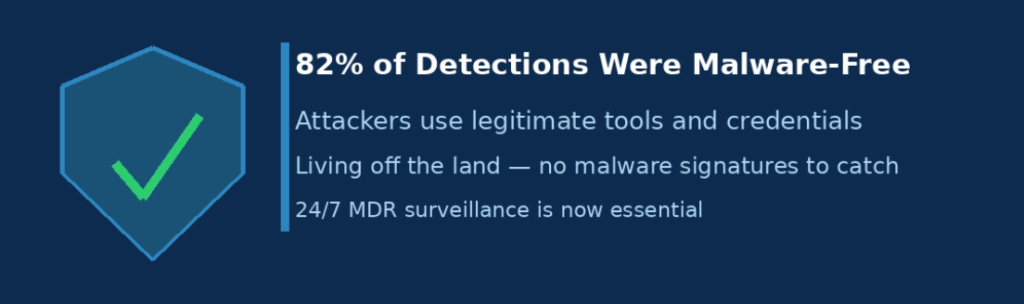

This is the statistic that really changes the conversation. Adversaries are living off the land, using valid accounts, approved SaaS integrations, and native tools to blend in with normal activity. Traditional antivirus that hunts for known malware signatures is increasingly ineffective.
Why This Validates Our Approach
ThreatDown Managed Detection and Response (MDR) is built exactly for this new reality. Their 24/7 expert team hunts for the subtle signs of evasive behaviour across endpoints, identity, cloud and SaaS, not just waiting for a malware signature to appear. When the average adversary is moving this fast, you need eyes on your environment around the clock, not just during business hours.
3. Ransomware Has Gone Fully Cross-Domain
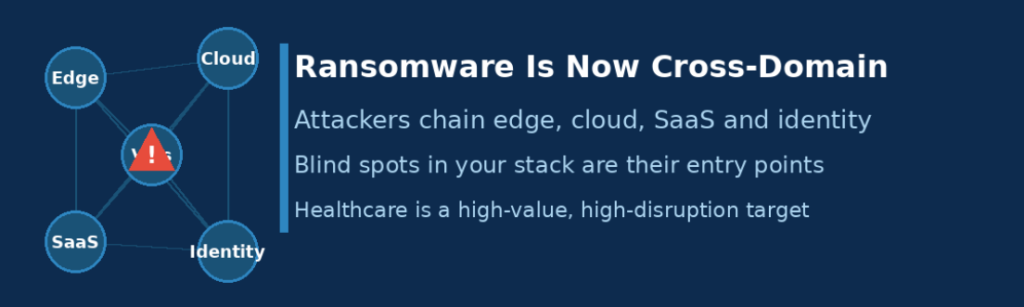

The big-game hunters (and even mid-tier groups) are now chaining together edge devices, cloud identity, unmanaged systems, virtual infrastructure and SaaS applications. They are deliberately targeting the “blind spots” that many organisations still have.
Healthcare practices are particularly attractive because of the value of patient data and the potential for operational disruption.
Why This Validates Our Approach
Our layered security model, combining Checkpoint at the perimeter with ThreatDown MDR across the entire environment, is designed to close those visibility gaps. We are not relying on a single tool or hoping the attacker only hits the parts we are watching. We have built the stack so that even if one layer is tested, the next layer is already providing detection and response.
What This Means for Your Clinic in 2026
No security solution is 100% impenetrable, as the report makes clear. But practices that have invested in modern, layered defence are dramatically better placed than those still relying on basic antivirus and occasional patching.
Our clients benefit because:
Their perimeter is actively defended against the exact edge-device attacks the report highlights. Their environment is under continuous expert surveillance for the fast, low-and-slow, malware-free intrusions that now dominate. We translate these global threat trends into practical, clinic-friendly controls that do not disrupt patient care or clinical workflows.Cybersecurity has never been more important for Australian healthcare. Patient privacy, accreditation, business continuity and your reputation all depend on staying ahead of these evasive adversaries.
If you are a Melbourne medical practice and you would like a no-obligation review of how your current setup stacks up against the threats outlined in the 2026 report, we are always happy to have the conversation. Drop us a line or book a quick call and we will walk you through what “better placed than most” actually looks like in practice.
